



With the abundance of health information available today, it can be hard to tell what is true or not. We all need access to trusted sources of information to stay safe and healthy.
Why health misinformation matters
We can all benefit from taking steps to improve the quality of health information we consume. Limiting misinformation helps us make more educated decisions for ourselves, our loved ones, and our communities.
Key Takeaways from the Advisory
A Surgeon General’s Advisory uses the best available science to shed light on major public health challenges and suggest possible solutions.
Defining misinformation
Misinformation is information that is false, inaccurate, or misleading according to the best available evidence at the time.
Effects related to COVID-19
During the pandemic, health misinformation has led people to decline vaccines, reject public health measures, and use unproven treatments. Health misinformation has also led to harassment and violence against health workers, airline staff, and other frontline workers tasked with communicating evolving public health measures.
How health misinformation spreads
The growing number of places people go to for information has made it easier for misinformation to spread at a never-before-seen speed and scale. Misinformation spreads especially easily on social media and online retail sites, as well as via search engines.
Addressing health misinformation
Together, we have the power to build a healthier information environment. Just as we have all benefited from efforts to improve air and water quality, limiting the prevalence and impact of misinformation benefits individual and public health.
How can we take action?
Everyone has the power to stop misinformation from spreading. By taking the following steps, we can protect ourselves and loved ones from harmful misinformation.
Ways to act based on your role
What individuals can do:
- Learn how to identify and avoid sharing health misinformation.
- Engage with your friends and family on the problem of health misinformation.
- Address health misinformation in your community.
What educators can do:
- Strengthen and scale the use of evidence-based educational programs that build resilience to misinformation.
- Educate students and the public on common tactics used by those who spread misinformation online.
- Establish quality metrics to assess progress in information literacy.
What health professionals can do:
- Proactively engage with patients and the public on health misinformation
- Use technology and media platforms to share accurate health information with the public
- Partner with community groups and other local organizations to prevent and address health misinformation.
What media and journalists can do:
- Train journalists, editors, and other media professionals to recognize, correct, and avoid amplifying misinformation.
- Proactively address the public’s questions.
- Provide the public with context to avoid skewing their perceptions about ongoing debates on health topics.
- Carefully review information in preprints.
- Use a broader range of credible sources—particularly local sources.
- Consider headlines and images that inform rather than shock or provoke.
What technology platforms can do:
- Give researchers access to useful data to properly analyze the spread and impact of misinformation.
- Strengthen the monitoring of misinformation.
- Prioritize early detection of misinformation “super-spreaders” and repeat offenders.
- Evaluate the effectiveness of internal policies and practices in addressing misinformation and be transparent with findings.
- Proactively address information deficits.
- Amplify communications from trusted messengers and subject matter experts.
- Prioritize protecting health professionals and journalists from online harassment.
What researchers can do:
- Strengthen the monitoring of health questions, concerns, and misinformation.
- Assess the impact of health misinformation.
- Prioritize understanding how people are exposed to and affected by misinformation, and how this may vary for different subpopulations.
- Evaluate the effectiveness of strategies and policies to prevent and address health misinformation.
What funders can do:
- Move with urgency toward coordinated, at-scale investment to tackle misinformation.
- Invest in quantifying the harms of misinformation and identifying evidence-based interventions.
- Provide training and resources for grantees working in communities disproportionately affected by misinformation (e.g., areas with lower vaccine confidence).
- Incentivize coordination across grantees to maximize reach, avoid duplication, and bring together a diversity of expertise.
What governments can do:
- Convene federal, state, local, territorial, tribal, private, nonprofit, and research partners to explore the impact of health misinformation and establish best practices for prevention.
- Increase investment in research on misinformation.
- Continue to modernize public health communications.
- Increase resources and technical assistance to state and local public health agencies to help them better address questions, concerns, and misinformation.
- Expand efforts to build long-term resilience to misinformation, such as educational programs.
Spread the word with these shareable tools
The Surgeon General’s Community Toolkit for Addressing Health Misinformation provides specific guidance and resources for health care providers, educators, librarians, faith leaders, and trusted community members to understand, identify, and stop the spread of health misinformation in their communities.
Developed in collaboration with the Office of Evaluation Sciences (OES).
Reasons to use the Community Toolkit video
A trailer video introducing the Community Toolkit that can be used for educational and training purposes.
Download - MP4 [61.3 MB]
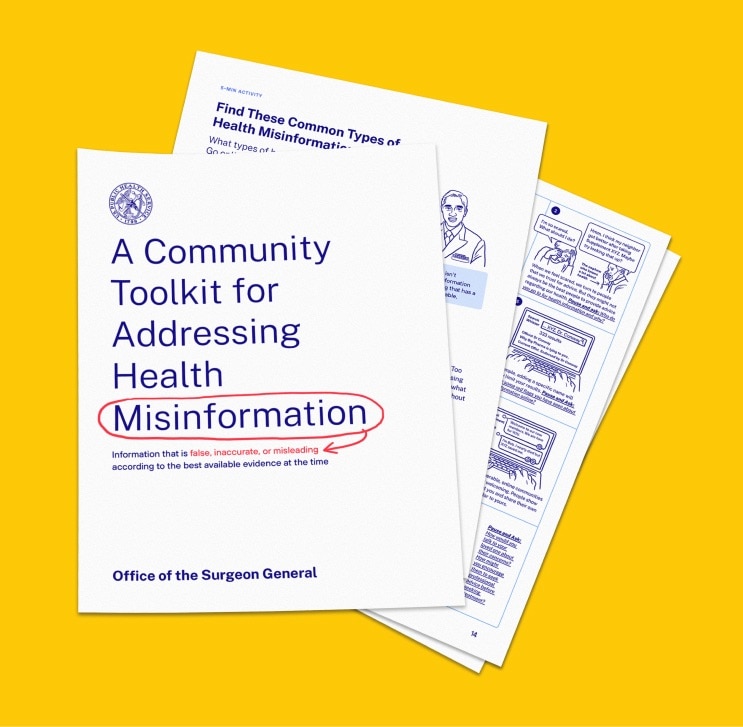
Community Toolkit
A 22-page overview of health misinformation and resources to stop it.
Download in English [2.6 MB]
Download in Spanish [4.3 MB]
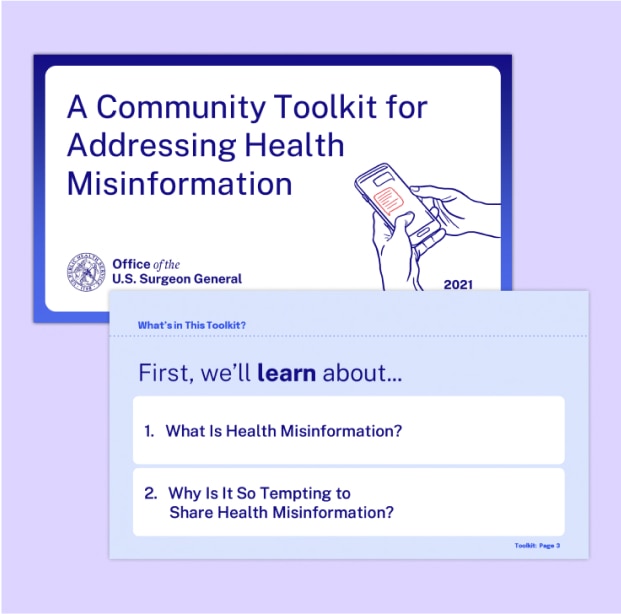
Teaching Slides
A slideshow version of the Community Toolkit for educators and other community leaders.
Download [22.4 KB]
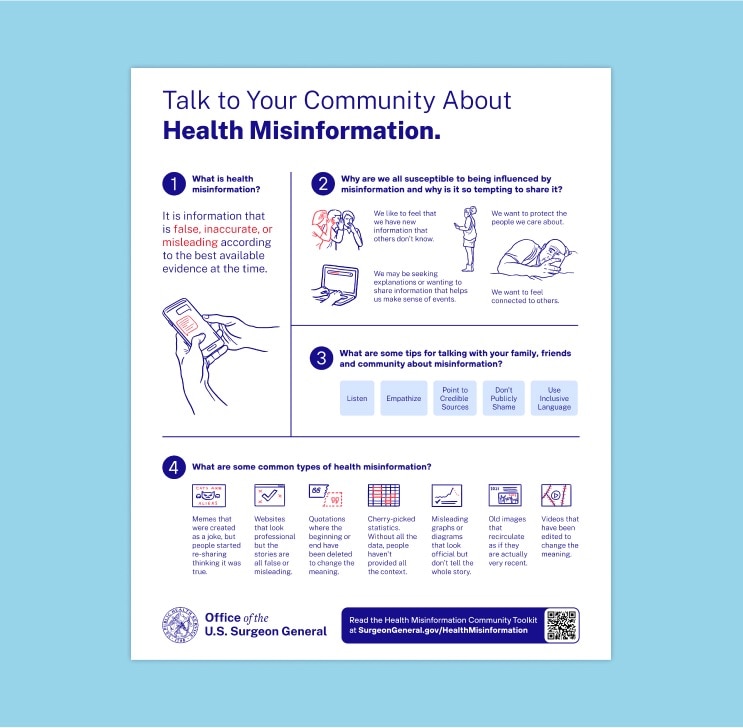
Talk to your community about health misinformation
An infographic with tips on how to talk to your community about health misinformation.
Download in English [322 KB]
Download in Spanish [1.2 MB]
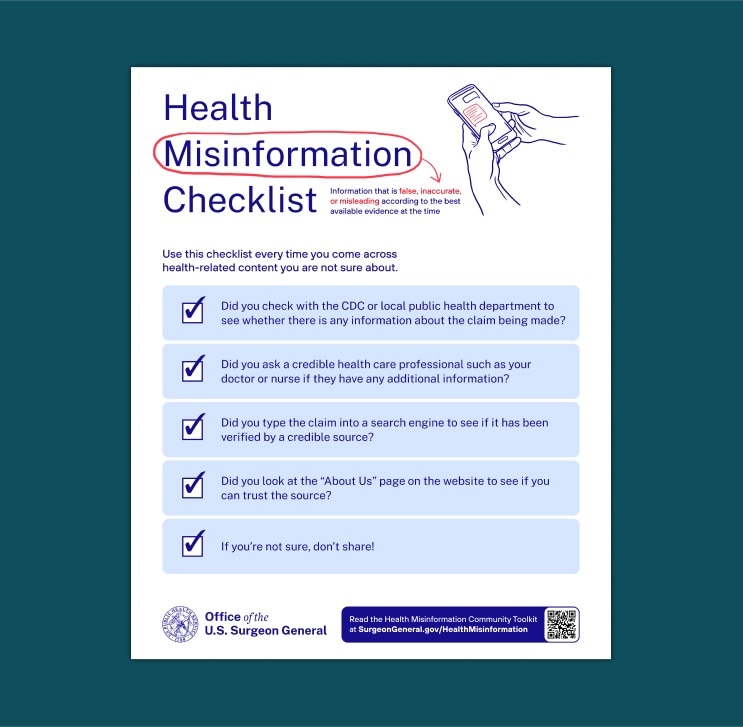
Health Misinformation Checklist
Use this checklist every time you come across health-related content you are not sure about.
Download in English [257 KB]
Download in Spanish [1 MB]
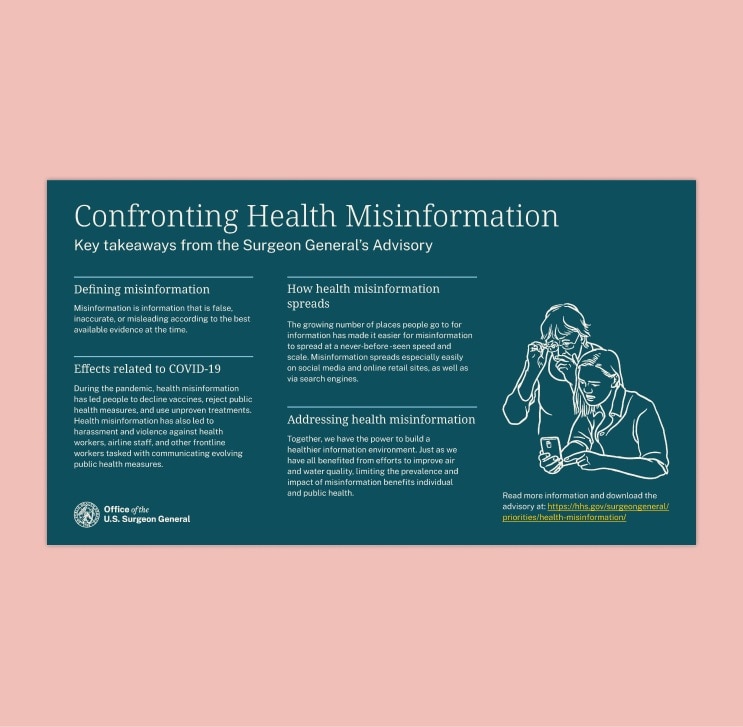
One-page summary (slide version)
This slide includes the key takeaways from the advisory.
Download [185 KB]
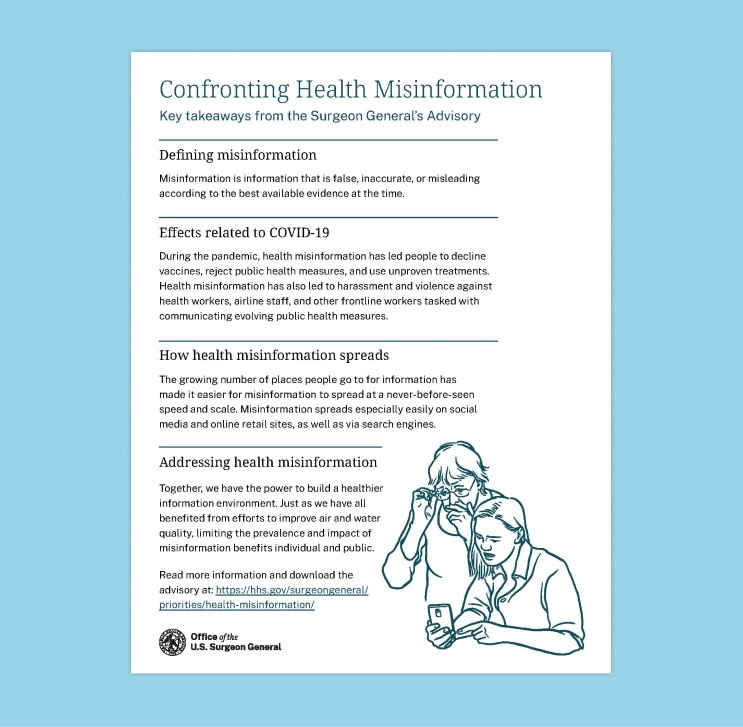
One-page summary (printable version)
This page includes the key takeaways from the advisory.
Download [169 KB]
Additional Resources
Myths and facts about COVID-19 vaccines
Accurate vaccine information is critical and can help stop common myths and rumors. It can be difficult to know which sources of information you can trust. Here is a guide from the CDC on the myths and facts about COVID-19 vaccination.
Share
- Share Myths and facts about COVID-19 vaccines to Facebook
- Share Myths and facts about COVID-19 vaccines to Twitter
- Share Myths and facts about COVID-19 vaccines on LinkedIn
- Share Myths and facts about COVID-19 vaccines in an email
Battling misinformation through health messaging
By Dana Litt and Scott Walters, March 24, 2021
This article provides guidance on best practices for detecting health misinformation and assessing the accuracy of different information sources.
Share
- Share Battling misinformation through health messaging to Facebook
- Share Battling misinformation through health messaging to Twitter
- Share Battling misinformation through health messaging on LinkedIn
- Share Battling misinformation through health messaging in an email
Health misinformation video
This trailer video introduces the Surgeon General’s “Confronting Health Misinformation” advisory and why it matters. This video can be used for educational and training purposes.
Share
- Share Health misinformation video to Facebook
- Share Health misinformation video to Twitter
- Share Health misinformation video on LinkedIn
- Share Health misinformation video in an email
Download - MP4 [80.4 MB]