Join our national effort to help families, schools, and communities reduce harmful screen use and create more opportunities for children to engage in the experiences essential to healthy development.
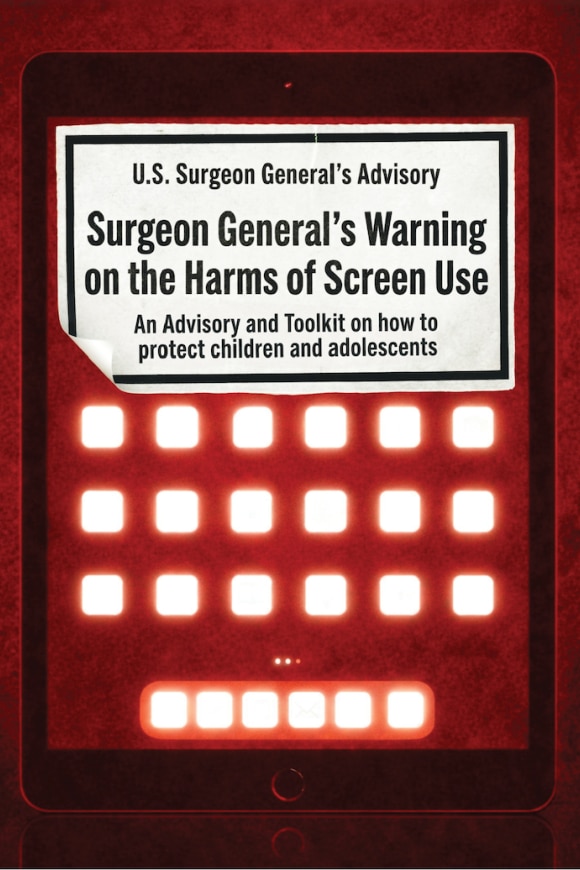
Surgeon General’s Advisory and Toolkit on the Harms of Screen Use
This advisory and toolkit provide science-based strategies to parents, caregivers, and educators that help promote healthy habits and reduce harm among our children and adolescents.
The Harms of Screen Use
Harmful screen use among children and adolescents has become a public health concern. With support from schools, communities, and governments, together we can shift the cultural norms around screens and help our children be healthier and happier nationwide.
A Surgeon General’s Advisory uses the best available science to shed light on major public health challenges and suggest possible solutions.
- Early exposure to screens carries developmental and cognitive risks. Screen use in early life is linked to poorer language outcomes.
- Excessive screen time is linked to poor educational and health outcomes in school aged children.
- In teenagers there are additional mental health and behavioral concerns, particularly related to social media use.
- Emerging concerns in adolescence are evolving with long term impacts that extend beyond childhood.
- A concern at all stages of life, and a particularly important one around children’s screen exposure, is its potential to disrupt healthy sleep, which is fundamental to learning, mood, behavior, physical health, and overall development.
- Screen time interventions show promise.
Reducing the negative impacts of harmful screen use requires acting with urgency and empowering caregivers and communities by providing them with evidence based tools and strategies organized around the 5 Ds.
- Discuss: Set expectations for all household members for healthy screen use. Discuss with youth what they are viewing, who they are interacting with, and how it makes them feel. Use parental controls and household rules that align with your goals.
- Do: Model the healthy screen use behaviors you would like to see. Children and adolescents pay attention to the actions of their caregivers and trusted adults. Be conscientious about how much time you spend on screens and what type of content you consume. When using screens, do so together.
- Delay: Delay screen time from the earliest age as long as possible and then establish and normalize age appropriate limits on time and content accessible. Parents and caregivers can also delay access to different devices by age.
- Divert: Provide alternatives so screen use is not the default when children are bored. Redirect attention and provide opportunities for healthy activities, such as physical activity. Prioritize completion of desirable activities first, such as chores, homework, music, or sports before screen use.
- Disconnect: Create regularly scheduled, screen free times in everyone’s day, such as mealtimes where everyone disconnects. Practice screen free time before bedtime for better quality sleep and avoid sleeping next to devices. Avoid multitasking with screens during activities. Detox completely from certain devices, media, or platforms when they have become a problem or when another goal is more important.
Downloadable Resource for Parents: The Magic Tablet
The Magic Tablet is designed as a companion to the Surgeon General’s advisory on the harms of screen use, encouraging children and adolescents to get off screens and live real life.

The Magic Tablet
Eleanor’s parents have one rule: no spending all day staring at screens. But Eleanor has an idea — if she can’t use a tablet, she’ll make one herself!
Armed with crayons, paper, and a big imagination, Eleanor and her baby brother set out to create a homemade “tablet” of their very own. Together, they draw, create, and play, discovering that they don’t need a glowing screen to explore new worlds or dream up exciting adventures. Their handmade tablet becomes a doorway to creativity — and to all the fun waiting in the world around them.
Sometimes the greatest adventures begin when you put down the screen, look up, and live real life.
Free Continuing Education Credits for Healthcare Professionals
Healthcare providers can now earn free continuing education (CE) credits while learning how to recognize and address the harms associated with screen use in children and adolescents.

Earn Continuing Education Credits
The Office of the Surgeon General, in partnership with the American College of Preventive Medicine (ACPM), is offering 1.5 AMA Category 1 Credits™ for the Advisory on the Harms of Screen Use and 1 AMA Category 1 Credit™ for the accompanying Toolkit.
The CE opportunity provides clinicians with an accredited way to engage with evidence-based guidance and practical resources they can use in conversations with patients and families. Eligible health care providers can register with ACPM through the following sites to claim credit.
This activity has been planned and implemented in accordance with the accreditation requirements and policies of the Accreditation Council for Continuing Medical Education (ACCME) through the joint providership of the American College of Preventive Medicine and the Office of the Surgeon General. The American College of Preventive Medicine is accredited by the ACCME to provide continuing medical education for physicians.
ACPM designates this enduring material for a maximum of 2.5 AMA PRA Category 1™ Credits. Physicians should claim only the credit commensurate with the extent of their participation in the activity.
ACPM is not accredited to offer credit to non-physicians. To determine if activities designated for AMA PRA Category 1™ Credit are acceptable for your licensing or certification needs, please contact your credentialing body directly.