
U.S. flag

An official website of the United States government

Here’s how you know

Dot gov

Official websites use .gov
A .gov website belongs to an official government organization in the United States.

HTTPS

Secure .gov websites use HTTPS
A lock (LockA locked padlock) or https:// means you’ve safely connected to the .gov website. Share sensitive information only on official, secure websites.

Freedom 250 banner logo Join HHS in Celebrating Freedom 250
    • About HHS

      HHS is a U.S. executive department that touches the lives of nearly all Americans by protecting your rights, research, food safety, health care, aging, and much more.

      Explore About HHS
    • About the Department
      • Leadership
      • HHS Divisions
      • Organizational Chart
      • Priorities
      • Budget in Brief
      • Contact Us
    • Press Room
      • Press Releases
      • Request for Comment
      • Request for Interview
      • Connect on Social Media
      • HHS Live
      • Podcasts
    • Careers
      • Working at HHS
      • Opportunities for Attorneys
      • Join the Health Workforce
      • I am HHS
      • New Employee Orientation
      • Transportation Services
    • Standards and Compliance
      • Gold Standard Science
      • Accessibility
      • Plain Writing
      • Digital Communications Standards
      • Records Management
    • Accountability and Transparency
      • Freedom of Information Act (FOIA)
      • Open Government
      • No Fear Act
      • Privacy at HHS
  • RealFood.gov
  • MAHA
    • Programs & Services

      HHS is responsible for public health, health care, and human/social services for the United States of America. This includes administering over 100 programs and services.

      Explore Programs & Services
    • Health Care
      • Find a Health Center
      • Find an Indian Health Service Facility
      • Find Support for Mental Health, Drugs, or Alcohol
      • Find a Cancer Center
      • Dental Care Options
      • Telehealth
    • Health Insurance
      • Medicare – 65+ or With Disability
      • Medicaid - Low-Income, With Disability, or Pregnant
      • Children’s Health Insurance Programs (CHIP)
      • Find Health Insurance Coverage
      • Insurance Help for Mental Health and Substance Use
      • No Surprise Medicals Bills
    • Social Services
      • Programs for Children and Families
      • Programs for People with Disabilities
      • Programs for Older Adults
      • Resources for Caregivers
    • Public Health and Prevention
      • Emergency Preparedness and Response
      • Healthy Lifestyle
      • Mental Health and Substance Use
      • Food Safety and Nutrition
      • Drug and Product Safety
    • Health Research and Information
      • National Library of Medicine
      • Surgeon General Reports
      • Health Data
      • National Center for Health Statistics
      • Medline Plus
      • Clinical Research Studies
      • Volunteering to Participate in Research
    • Laws & Regulations

      HHS protects and helps you understand the laws and regulations, also known as "rules," that govern the nation. You also have the power to voice your opinion on these laws and regulations.

      Explore Laws & Regulations
    • Regulatory Information
      • What is a Rule?
      • Find Rules by Division
      • Comment on Open Rules
      • Suggest Deregulatory Actions
      • Understand Key Federal Laws
    • Civil Rights
      • Your Civil Rights
      • Civil Rights Laws Enforced by HHS
      • Health Information Privacy
      • Substance Use Disorder Patient Confidentiality
      • Conscience and Religious Freedom
    • Laws and Regulations by Topic
      • HIPAA Privacy Rule
      • Health Insurance Protections
      • Health IT Legislation
      • Food and Drug Safety
      • Public Health Emergencies
    • Human Research Protections
      • The Belmont Report
      • Regulations, Policy, and Guidance
      • Human Subjects Regulations (45 CFR 46)
      • Register IRBs and Obtain FWAs
      • Trainings, Tutorials, and Workshops
      • International Research
    • Complaints and Appeals
      • File a Medicare Complaint
      • File a HIPAA Complaint
      • File a Civil Rights Complaint
      • Appeal an Insurance Company Decision
      • Report Fraud, Waste, and Abuse to OIG
      • Report a Problem to the FDA
      • Report a Tip on the Chemical and Surgical Mutilation of Children
    • Grants & Contracts

      HHS gives the most money in grants of any federal agency in the U.S. Find out about our grants and how your organization can apply for them. We also provide information on how you can work with us and our support of small businesses.

      Explore Grants & Contracts
    • Grants
      • Get Ready for Grants Management
      • Grant Policies and Regulations
      • Research Grants and Funding from NIH
      • Search Grants.gov
      • Avoid Grant Scams
      • Contact HHS Grant Officials
    • Contracts
      • Get Ready to Do Business with HHS
      • Programs for Businesses
      • Contract Policies and Regulations
      • Search Opportunities on SAM.gov
      • Contact HHS Contracting Managers
    • Small Business
      • Contract Opportunities
      • Small Business Programs
      • Small Business Resources
      • Contact Small Business Staff
    • Radical Transparency

      HHS protects and helps you understand the laws and regulations, also known as "rules," that govern the nation. You also have the power to voice your opinion on these laws and regulations.

      Explore Radical Transparency
    • CDC’s ACIP Conflicts of Interest
    • Ending Anti-Semitism on College Campuses
    • Ending Wasteful Spending
    • Keeping Food Ingredients Safe
    • Chemical Contaminants Transparency Tool
Breadcrumb
  1. Home
  2. Viral Hepatitis
  3. Learn About Viral Hepatitis
  4. Data and Trends
  • Viral Hepatitis
    • Learn About Viral Hepatitis
      • Hepatitis A Basics
      • Hepatitis B Basics
      • Hepatitis C Basics
      • Data and Trends
    • Viral Hepatitis National Strategic Plan
      • Overview
      • Developing Plan
      • Priority Populations
      • Goals, Objectives, and Strategies
      • Viral Hepatitis Federal Implementation Plan
      • Communications Toolkit
      • Prior Viral Hepatitis National Strategic Plans
    • Policies and Guidelines
      • Affordable Care Act
    • Programs and Initiatives
      • Mapping Hepatitis Elimination in Action
      • Addressing Reimbursement in Viral Hepatitis Integration of Prevention and Care Services
      • Evaluation of Linkage to Care Programs in Support of Hepatitis C Elimination
      • Viral Hepatitis Quality Measures
    • Webinars, Videos, and Training
    • Awareness Months and Days

Viral Hepatitis in the United States: Data and Trends

Millions of Americans from all walks of life are living with viral hepatitis, and most don’t know they have the virus.

  • 2.4 million people are estimated to be living with hepatitis C in the United States. The actual number may be as high as 4.7 million or as low as 2.5 million.1
  • 850,000 people in the U.S. are estimated to be living with hepatitis B. The actual number may be as high as 2.2 million or as low as 730,000.2
  • More than half of persons living with hepatitis do not know that they have the virus. Thus, they are at risk for life threatening liver disease and cancer and unknowingly transmitting the virus to others.
    • 67% of persons living with hepatitis B infection do not know they have the virus.
    • 51% of persons living with hepatitis C infection do not know they have the virus.
  • In 2018:
    • Millennials (most adults in their 20s and 30s) made up 36.5% of newly reported chronic hepatitis C infections.
    • Baby boomers (most adults in their mid-50s to early 70s) made up 36.3% of newly reported chronic hepatitis C infections.
    • Generation X (adults in their late 30s to early 50s) made up 23.1% of newly reported chronic hepatitis C infections.
  • Asian Americans and Pacific Islanders are the racial/ethnic groups that are most heavily affected by hepatitis B virus. Asian Americans and Pacific Islanders represent about 5% of the U.S. population, but they represent about half of all persons living with hepatitis B. As a result, 1 in 12 Asian Americans and Pacific Islanders are living with hepatitis B.

Hepatitis C infections are increasing in the United States.

  • Acute hepatitis C infections increased 250% from 2010 to 2014.
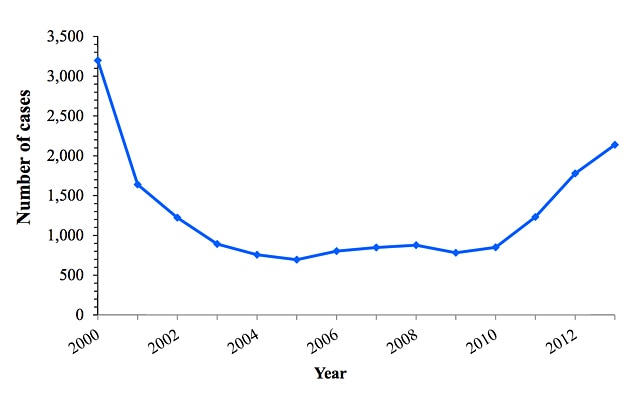
 

Chart showing incidence of acute hepatitis C in the United States decreased from 2000-2005 but has been steadily increasing since 2010.
Reported number of acute hepatitis C cases – United States 2000-2014
  • The rate of new hepatitis C infections reported to CDC in 2018 was four times as high as it was in 2010.
  • 2018 marked a decade of increases in new hepatitis C infections among people in their 20s and 30s, with injection drug use as the primary route of transmission.
  • Acute hepatitis C infections increased 364% from 2006 to 2012 in four states affected by the opioid epidemic (Kentucky, Tennessee, Virginia, and West Virginia).

Increases in hepatitis B infections are being fueled by the opioid and heroin use epidemics that are gripping many communities across the United States.

  • After decades of declines in new cases, progress on hepatitis B prevention has stalled in the US as a whole and, in some states, hepatitis B infections have increased.
  • Acute hepatitis B infections increased 114% from 2006 to 2013 in three states affected by the opioid epidemic (Kentucky, Tennessee and West Virginia).
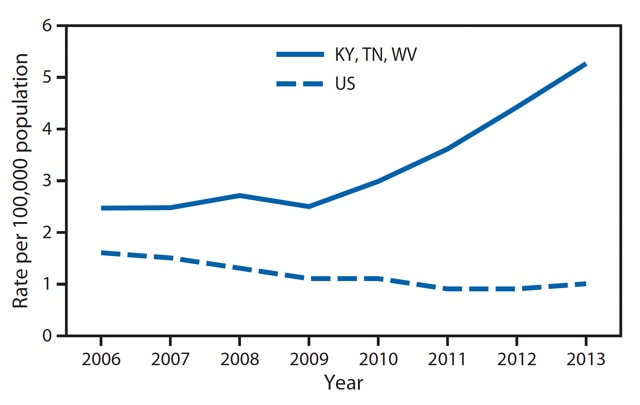
 

Incidence of acute hepatitis B virus infection has overall decreased in the United States but increased in Kentucky, Tennessee, and West Virginia from 2006 to 2013.
Incidence of acute hepatitis B virus infection by year in the United States and Kentucky, Tennessee, and West Virginia from 2006 to 2013.


Hepatitis B and C are responsible for increasing rates of liver cancer and premature deaths.

  • Viral hepatitis is a leading cause of liver cancer.
  • Unlike other types of cancers, rates of liver cancer have been increasing in the United States.
    • Rates of new liver cancer cases increased 38% from 2003 to 2012.3
    • Liver-cancer related death rates are increasing. Almost 23,000 people died from liver cancer in 2012. This is a 56% increase in deaths since 2003.
    • More men die from liver cancer, but rates are increasing more quickly among women. From 2008 to 2012, the liver cancer-related death rate increased by an average 2.8% per year among men and 3.4% per year among women.
  • Since 2012, there have been more deaths due to hepatitis C than all 60 of the other reportable infectious diseases combined.
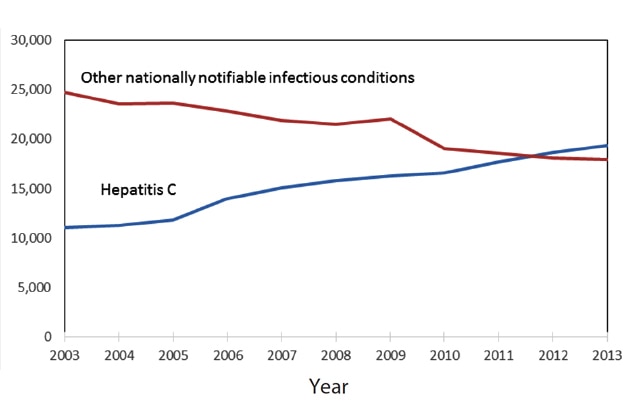
 

Chart showing nationally notable infectious diseases decreasing since 2003, but HCV has increased in that time
HCV Deaths and Deaths from Other Nationally Notifiable Infectious Diseases, 2003-2013

------

1 http://www.ncbi.nlm.nih.gov/pubmed/26171595

2 http://onlinelibrary.wiley.com.ezproxyhhs.nihlibrary.nih.gov/doi/10.1002/hep.28109/epdf Roberts et al

3 http://www.cdc.gov/cancer/dcpc/research/articles/arn_7512.htm

Content last reviewed June 7, 2016
Back to top
Secretary Robert F. Kennedy Jr.

Follow @SecKennedy

HHS icon

Follow @HHSGov

HHS Email updates

Receive email updates from HHS.

Subscribe

HHS Logo

HHS Headquarters

200 Independence Avenue, S.W.
Washington, D.C. 20201
Toll Free Call Center: 1-877-696-6775​

  • Contact HHS
  • Careers
  • HHS FAQs
  • Nondiscrimination Notice
  • Press Room
  • HHS Archive
  • Accessibility Statement
  • Budget/Performance
  • Inspector General
  • Web Site Disclaimers
  • EEO/No Fear Act
  • FOIA
  • The White House
  • USA.gov
  • Vulnerability Disclosure Policy